
Introduction
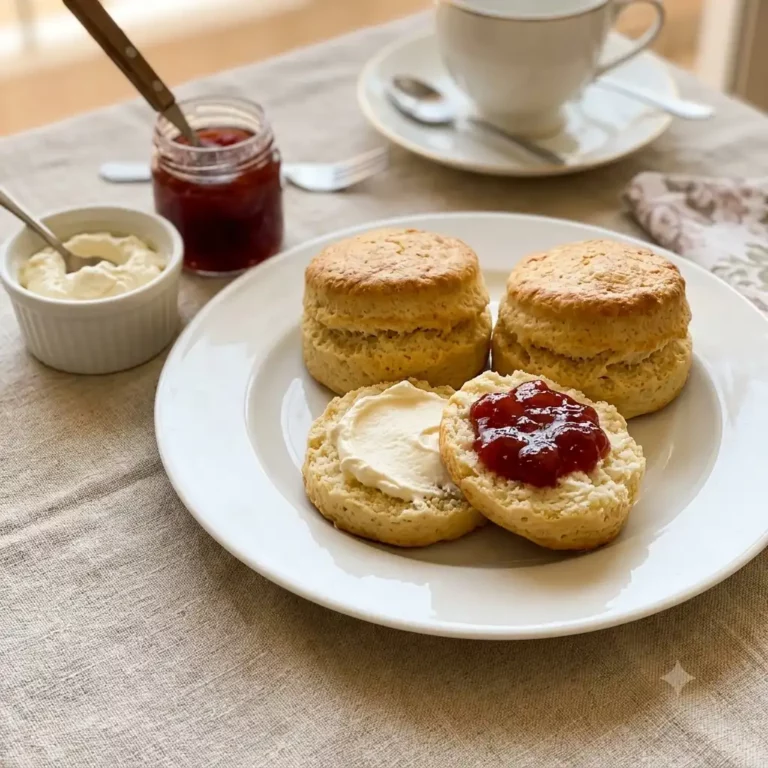
These Classic British Cream Scones are the ones I bake when I want something that looks and tastes genuinely traditional — tall, slightly golden, with a tight, tender crumb that splits horizontally along a natural fault line, revealing the perfect surface for a thick spread of clotted cream and a generous spoonful of strawberry jam. These are not the American triangle scone loaded with mix-ins. These are the round, modest, gloriously simple British version that has been served at afternoon tea for centuries for very good reason.
What makes this classic british cream scones recipe clotted cream so different from American scones is the restraint. No vanilla, no grated butter, no buttermilk, no add-ins — just flour, cream, a little sugar, baking powder, and a pinch of salt, mixed until just combined, patted gently, cut with a straight-sided cutter, and baked until just golden. The simplicity is what makes the clotted cream and jam the stars rather than the scone itself.
The result is a scone that is light and tender rather than flaky and buttery — closer to a soft bread roll in texture than an American biscuit — which is exactly the right vehicle for a generous application of clotted cream and jam. If you love a more richly flavored, American-style flaky scone with bold mix-ins using the same cold butter technique, these easy buttermilk vanilla scones with berry jam use frozen grated butter and buttermilk for a completely different flaky, layered American scone direction.
Why You’ll Love This Recipe
These Classic British Cream Scones use heavy cream rather than butter worked into flour — the cream provides both the fat and the liquid in a single ingredient, which makes the mixing process significantly simpler and more foolproof than any method involving cold butter.
The recipe takes under 30 minutes from cold bowl to warm scone — about 10 minutes of mixing and shaping and 12 to 14 minutes of baking.
This classic british cream scones recipe clotted cream uses just five ingredients — self-raising flour, cream, sugar, baking powder, and salt — all of which are genuine pantry staples that most people already have.
The scones reheat beautifully — split and warm in a 300°F oven for 5 minutes or toast lightly for a slightly crunchy exterior that’s genuinely excellent with clotted cream.
The recipe scales easily — double it for a full cream tea for six to eight people with almost no additional effort.
Advertisements
About the Ingredients
Self-Raising Flour or All-Purpose Flour with Baking Powder
Traditional British cream scones are made with self-raising flour, which is all-purpose flour with baking powder and salt already incorporated. In the United States, substitute 2 cups of all-purpose flour plus 2 teaspoons of additional baking powder and ½ teaspoon of salt. The flour provides structure and the leavener creates the rise that produces the characteristic tall, round scone shape in these Classic British Cream Scones. Do not substitute bread flour — its higher protein content creates a tough, chewy scone rather than the tender, slightly crumbly texture that defines a proper British cream scone.
Heavy Cream
Heavy cream replaces the cold butter that most scone recipes call for — the fat content of the cream does the same job of shortening the gluten strands and creating tenderness while simultaneously providing the liquid that brings the dough together. King Arthur Baking’s comprehensive scone baking guide confirms the defining textural difference directly: scones made with cream are rich and cake-like, while scones made with butter are tender and flaky. That distinction is exactly why these Classic British Cream Scones have the soft, slightly crumbly, tender crumb that makes them the right vehicle for clotted cream and jam — they are not trying to compete with the topping, they are the canvas for it. Start with ¾ cup of cold cream and add the final tablespoon or two only if the dough needs it — it should come together in a soft, slightly tacky dough that is not sticky.
Advertisements
Sugar
Two tablespoons of caster sugar (or fine granulated sugar) adds a subtle sweetness that balances the tang of the jam and the richness of the clotted cream without making the scone taste like a dessert. Traditional British scones are only very lightly sweetened — the sweetness comes from the jam, not from the scone itself.
Baking Powder
A generous amount of baking powder provides the rise that produces the characteristic height of a proper British cream scone. The visual test of a well-made British scone is the clear horizontal rise line around the middle — the natural split point that develops during baking. Fresh baking powder is essential in these Classic British Cream Scones — expired leavener produces flat scones with no visible rise line.
Advertisements
Clotted Cream
Clotted cream is the non-negotiable accompaniment that makes a British cream scone complete. Made by slowly heating unpasteurized cream until the fat content rises to the surface and clots, it has a rich, slightly sweet, butter-like flavor with a thick, spreadable texture. It’s widely available in the US in specialty grocery stores, British import shops, and online. As a substitute, mascarpone mixed with a small amount of heavy cream produces a reasonable approximation of the texture and richness in this classic british cream scones recipe clotted cream pairing. In Cornwall, cream goes first then jam. In Devon, jam goes first then cream. Both are correct depending on which county you ask.
Strawberry Jam
A good quality strawberry jam with whole pieces of fruit is the traditional partner for clotted cream on a British scone. The bright acidity and sweetness of the jam cuts through the richness of the clotted cream beautifully. Raspberry jam is an excellent alternative with a slightly more tart, complex flavor.
Tips and Tricks
Do not overwork the dough — this is the most important instruction in the entire recipe for these Classic British Cream Scones. Mix until the dough just comes together, turn onto a surface, and handle as little as possible. Overworked dough develops gluten that produces a dense, tough scone rather than the tender, slightly crumbly texture that defines a proper British cream scone.
Pat the dough gently to a height of about 1 inch — no thinner. The height of the cut dough directly determines the height of the finished scone.
Use a straight-sided, sharp-edged round cutter and press straight down without twisting in this classic british cream scones recipe clotted cream recipe. Twisting seals the sides and prevents the characteristic horizontal rise line from forming during baking.
Brush the tops with a little milk or beaten egg before baking for a deeply golden top — brush only the top surface, not the sides, as glazing the sides also prevents the rise line from forming.
Pro Tips
Chill the mixed dough for 15 minutes before cutting if the cream has warmed it slightly — cold dough holds its shape during cutting and produces taller, more defined scones with a cleaner rise line in these Classic British Cream Scones.
Gather scrap dough from the first cutting, press together gently once, and cut again — but handle as minimally as possible. Second-cut scones rise slightly less dramatically than first-cut, but are otherwise identical.
Bake scones close together on the tray — touching or nearly touching — they support each other during baking and rise straighter and taller than scones baked with space between them in this easy homemade british scones clotted cream style.
Serve within 20 minutes of baking for the best texture — cream scones stale faster than butter scones because the cream fat doesn’t coat the gluten strands as durably as solid butter does.
Step-by-Step Instructions
- Preheat oven to 425°F (220°C). Line a baking sheet with parchment paper.
- In a large bowl, sift together 2 cups of self-raising flour (or 2 cups all-purpose flour plus 2 teaspoons baking powder and ½ teaspoon salt) and 2 tablespoons of caster or fine granulated sugar.
- Make a well in the center and pour in ¾ cup of cold heavy cream.
- Mix with a butter knife or fork using a cutting motion rather than a stirring motion — cutting the cream into the flour rather than stirring develops less gluten and produces a more tender scone. Mix until the dough just comes together in a soft, slightly shaggy mass.
- Turn onto a lightly floured surface. Gently and quickly pat to 1-inch thickness — do not knead or roll.
- Use a sharp-edged 2-inch round cutter to cut rounds, pressing straight down without twisting.
- Place on the lined baking sheet close together — touching or nearly touching.
- Brush only the tops (not the sides) with a little milk or beaten egg.
- Bake for 12 to 14 minutes until the tops are golden and the rise line is clearly visible around the middle.
- Remove from the oven and cool on a wire rack for 5 minutes.
- Serve warm, split horizontally, with clotted cream and strawberry jam.
Variations
Cheese and chive version: Omit the sugar and add ¾ cup of finely grated sharp cheddar and 2 tablespoons of finely snipped fresh chives to the flour before adding the cream for a savory version of these Classic British Cream Scones that pairs beautifully with soup and works as a dinner bread.
Dried fruit version: Fold ½ cup of sultanas (golden raisins) or dried currants into the dough just before the final pat-out for a fruit scone direction that is traditional in many parts of Britain and especially popular served warm with butter rather than clotted cream.
Lemon poppy seed version: Add the zest of one lemon and 1 tablespoon of poppy seeds to the flour before adding the cream for a bright, citrus direction in this classic british cream scones recipe clotted cream that pairs especially well with lemon curd instead of jam.
Lavender honey version: Add 1 teaspoon of dried culinary lavender to the flour and replace the caster sugar with honey stirred into the cream before adding for a floral, slightly exotic direction that’s especially elegant for a summer afternoon tea.
Whole wheat version: Replace half the all-purpose flour with whole wheat flour for a slightly earthier, more textured scone with more fiber that still rises well and pairs beautifully with the same clotted cream and jam in this easy homemade british scones clotted cream recipe.
How to Store
Store Classic British Cream Scones in an airtight container at room temperature for up to 2 days. They stale faster than butter scones — plan to eat them fresh or reheat before serving. Split and warm in a 300°F oven for 5 minutes for a texture that’s close to fresh-baked.
Freeze unbaked cut scones on a tray until solid then bag for up to 2 months. Bake from frozen at 425°F for 16 to 18 minutes — the results are excellent and genuinely indistinguishable from fresh-made dough.
Freeze baked scones individually wrapped for up to 1 month. Thaw at room temperature for 30 minutes then warm in the oven before serving — not the microwave, which makes them gummy.
Frequently Asked Questions
Why don’t my Classic British Cream Scones have a rise line?
Either the cutter was twisted rather than pressed straight down (which seals the sides), the dough was overworked (which develops too much gluten to allow the natural split), or the sides were glazed with egg wash (which seals them and prevents rising). Press straight down, handle minimally, and glaze only the top surface.
What is clotted cream and where do I find it?
Clotted cream is a thick, slightly sweet cream made by slowly heating cream until the fat rises and clots. It’s available in specialty grocery stores, British import shops, Trader Joe’s occasionally, and online. Mascarpone thinned with a little heavy cream is the closest widely available substitute.
Can I make this classic british cream scones recipe clotted cream version without self-raising flour?
Yes — use 2 cups of all-purpose flour plus 2 teaspoons of baking powder and ½ teaspoon of salt. Sift together twice for even distribution.
Cream first or jam first?
In Devon, jam is spread first and cream spooned on top. In Cornwall, cream goes first and jam on top. Both are correct — this is one of Britain’s most passionately contested culinary debates.
Can I use milk instead of heavy cream?
You can but the scone will be less tender and rich. Whole milk produces a noticeably lighter, slightly drier scone. Heavy cream is what makes these genuinely luxurious in this Classic British Cream Scones recipe.
What can I serve alongside these Classic British Cream Scones?
These scones are the centerpiece of a proper afternoon tea. For a warm, savory scone to offer alongside the sweet cream scones at the same brunch spread, these savory bacon cheddar chive scones use the same scone format with crispy bacon, sharp cheddar, and fresh chives for a savory contrast that makes an especially complete brunch pairing.
Classic British Cream Scones
Equipment
- large mixing bowl
- Sifter or fine mesh strainer
- parchment-lined baking sheet
- 2-inch sharp-edged round pastry cutter
- Pastry brush
- Wire cooling rack
Ingredients
Cream Scone Dough
- 2 cups self-raising flour or 2 cups all-purpose flour + 2 tsp baking powder + ½ tsp salt
- 2 tbsp caster sugar or fine granulated sugar
- 0.75 cup cold heavy cream plus 1 to 2 extra tablespoons if needed
Glaze
- 2 tbsp whole milk or 1 beaten egg for brushing tops only — not sides
For Serving
- clotted cream generous amount per scone
- strawberry or raspberry jam good quality with whole fruit pieces
Instructions
- Preheat oven to 425°F (220°C). Line a baking sheet with parchment paper.
- Sift flour, sugar, and salt (if using all-purpose flour, add baking powder too) into a large bowl.
- Make a well in the center. Pour in ¾ cup of cold heavy cream. Mix with a butter knife using a cutting motion until the dough just comes together in a soft, slightly shaggy mass — do not stir or overwork.
- Turn onto a lightly floured surface. Gently pat to 1-inch thickness — do not knead or roll.
- Use a sharp 2-inch round cutter to cut rounds, pressing straight down without twisting. Place close together on the baking sheet — touching or nearly touching.
- Brush only the tops (not the sides) with milk or beaten egg.
- Bake 12 to 14 minutes until golden on top with a clearly visible horizontal rise line around the middle. Cool on a wire rack 5 minutes.
- Serve warm, split horizontally, with clotted cream and strawberry jam.
Notes
Advertisements